
2.png)
Rewire Your Thinking to Finally Stop Self-Sabotage
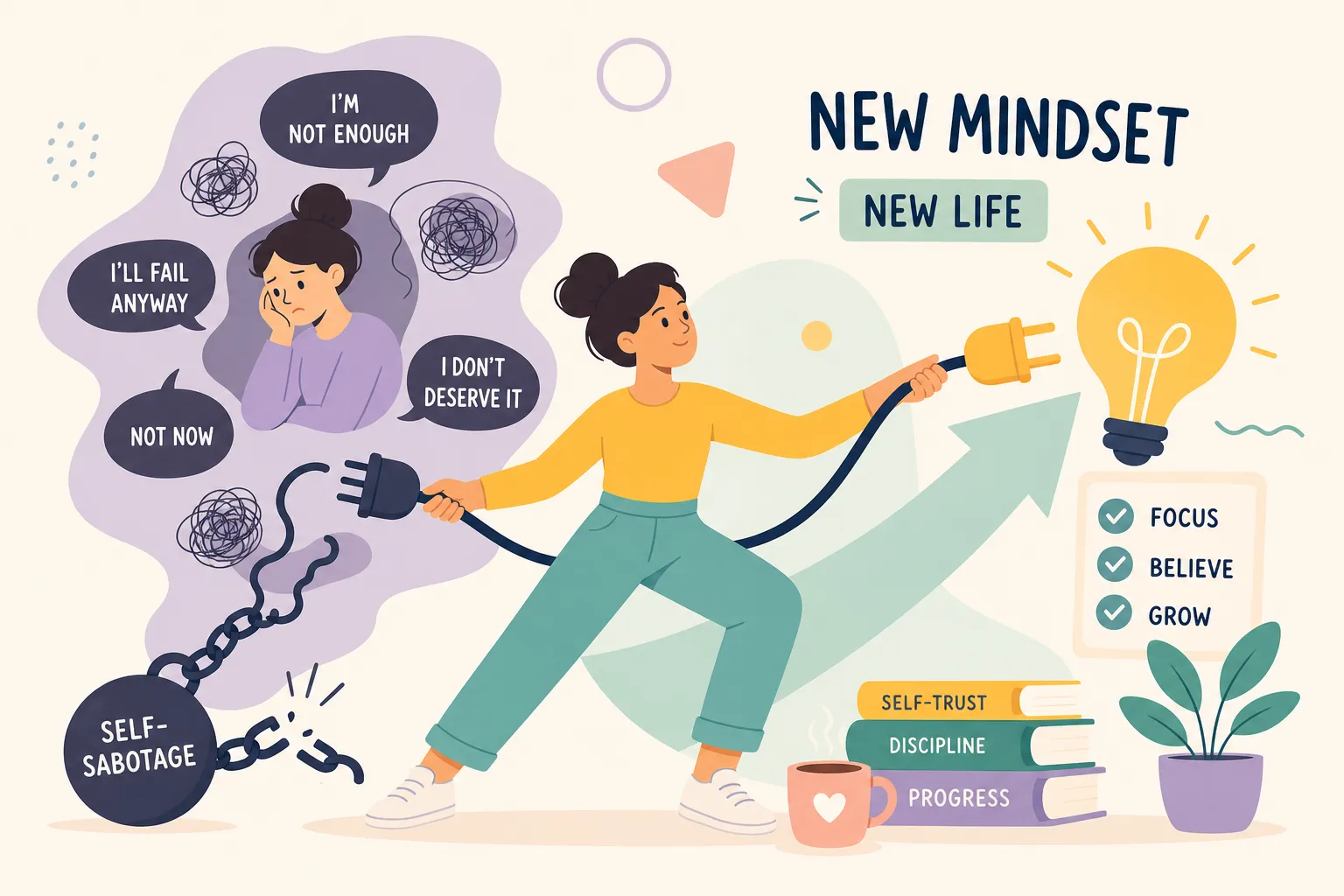
How do I rewire my thinking to stop self-sabotage and start succeeding? It's one of the most searched questions in personal development, and one of the least honestly answered. Most people who self-sabotage aren't lazy. Research shows self-sabotage is common even among high-achieving individuals who are skilled at masking or rationalizing the behavior. The problem isn't effort or intelligence. The real issue is what happens in the mind just before the effort begins, that crucial moment where familiar avoidance overrides genuine intention.
The name Change Your Thinking Change Your Life isn't just a catchy phrase. It reflects a documented psychological principle: your thinking patterns strongly influence many of the outcomes you're trying to escape, often more than circumstances alone. Research from the American Psychological Association has found that 71% of adults engage in at least one form of self-sabotage regularly, though the specific figures vary by study and population. That's not a fringe problem. It's a near-universal one.
This article covers the psychology behind why it happens, what neuroscience actually says about changing it, and a seven-step framework with a 30-day plan to break self-defeating patterns for good. There's also a paradox worth sitting with before you read further: the smarter you are, the better you are at justifying the very behaviors holding you back.
Why Smart People Fall Into Self-Sabotage Cycles
High cognitive ability doesn't protect you from self-sabotage. In many cases, it makes you better at rationalizing it. The brain doesn't cleanly distinguish between "this is genuinely dangerous" and "this might expose me to judgment." Both signals travel through overlapping threat-detection circuitry, including regions like the amygdala involved in social and identity threat, and often arrive at the same destination: avoidance.
Picture the capable person who keeps almost finishing the business plan. Almost applying for the promotion. Almost launching the project they've been refining for two years. It isn't incompetence stopping them. The brain has flagged unfamiliar success as a potential threat, and familiar discomfort feels safer than unknown territory. This isn't a character flaw, it's a protection mechanism operating exactly as designed, just in the wrong context.
This distinction matters more than most people realize. When you stop framing self-sabotage as a willpower problem and start seeing it as a wiring problem, the first real mindset shift toward success becomes possible. You can't discipline your way out of a pattern you haven't accurately diagnosed.
The Four Cognitive Patterns Fueling the Cycle
Procrastination and perfectionism look different on the surface but share the same root. Procrastination is fear of failure wearing the disguise of delay. Perfectionism is fear of inadequacy wearing the disguise of high standards. Both produce the same outcome: inaction. Both feed on the same family of cognitive distortions: all-or-nothing thinking ("if it's not perfect, it's worthless"), catastrophizing ("if I fail publicly, everything collapses"), and overgeneralization ("I always blow it at the last minute").
The insidious part of these distortions is that they become self-confirming. You avoid the thing, you never disprove the fear, the fear grows stronger, and the avoidance deepens. Repeat for years and the pattern feels like personality rather than habit.
Negative self-talk often operates automatically, outside deliberate awareness. It runs a quiet, continuous audit of your limitations, and because it's quiet, most people don't catch it until the damage is done. Journaling and trigger-tracking are the primary tools for surfacing it. Write down when you acted against your own interests, what you felt beforehand, and what set it off. Facts only, no self-criticism during the recording phase.
Less discussed but equally destructive is the fear of success. When success means higher expectations, greater visibility, or a disruption to your current identity, the brain sometimes sabotages outcomes to avoid those consequences. The diagnostic question that cuts to the root: "What's the worst thing that would happen if I didn't sabotage this?" The answer is almost always more revealing than any personality assessment.
What Neuroscience Actually Says About Rewiring Old Patterns
Hebb's Law, stated simply: neurons that fire together, wire together. Repeated thoughts and behaviors strengthen the neural connections associated with them, while unused connections weaken over time. This is why self-defeating patterns persist even when you clearly know better. You've rehearsed them thousands of times. The pathway is well-worn and fast.
One number worth knowing: according to research by Phillippa Lally and colleagues at University College London (2010), new behaviors take a median of 59 to 66 days to become automatic, with a range of 18 to 335 days depending on complexity. Not 21 days. The "21-day habit" figure has no scientific basis, and it's done real damage by setting people up to quit before the rewiring is anywhere near complete.
Here's the other critical distinction: understanding why you self-sabotage does not automatically stop it. Awareness is necessary but insufficient. The brain requires repeated corrective experiences to build competing neural pathways. Insight without new behavior is just informed inaction.
What does trigger structural change is sustained, emotionally engaged new practice. Emerging neuroscience research points to what some researchers describe as a plasticity cascade, a chain of molecular events that shifts the brain from temporary signal changes toward actual structural modification. Old pathways don't disappear. They get outcompeted by stronger new ones. The goal is repetition, not revelation.
How Do I Rewire My Thinking to Stop Self-Sabotage? Seven Practical Steps
1. Track Your Triggers
Keep a daily journal noting when you acted against your own interests, what you felt in the moments before, and what set it in motion. Record facts only, no self-judgment during this phase. The data is more useful than the self-criticism.
2. Name the Cognitive Distortion
Label the thought pattern the moment it appears: perfectionism, catastrophizing, all-or-nothing thinking. Naming it creates psychological distance. You can't challenge what you haven't identified.
3. Apply Cognitive Restructuring
Challenge the self-defeating thought with evidence. Ask: "Is this a fact or a feeling?" Then replace it with a neutral, accurate alternative. This isn't toxic positivity, it's accuracy. The goal is a thought that holds up under scrutiny, not one that feels good for 20 minutes.
4. Use Thought Labeling from ACT
Instead of believing the thought, label it as a mental event: "I'm having the thought that I'll fail." This weakens the thought's authority without requiring you to suppress it. Suppression tends to amplify. Distance tends to deflate.
5. Build If-Then Plans
Pre-set your response to known triggers before they hit. "If I feel the urge to postpone this task, then I will do the two-minute version." Removing the in-the-moment decision eliminates the negotiation window where avoidance wins.
6. Design Your Environment
Remove friction from new behaviors. Add friction to old ones. The brain automates whatever is easiest to repeat. Think of this as applied neuroscience, working with the grain of how behavior actually forms rather than against it.
7. Celebrate Micro-Wins Deliberately
Dopamine released by recognizing small wins fuels neuroplasticity and teaches the brain to repeat the associated behavior. Silence after progress is a missed reinforcement opportunity. Acknowledge what went right, even when it feels small.
A 30-Day Plan to Rewire Your Thinking and Start Succeeding
Week 1 (Establish): Focus on consistency over perfection. Execute the minimum viable version of each new thought or behavior daily. Target six out of seven days. Miss once, never twice. The goal this week is proof of concept, not performance.
Week 2 (Stabilize): Resistance peaks here. This is predictable, not personal. Pre-plan for the specific obstacle that tripped you up in Week 1, identify it before it arrives and pre-decide your response. Most people quit in Week 2 because they interpret normal resistance as evidence the method isn't working.
Week 3 (Integrate): The behavior begins feeling more natural. If the minimum version feels genuinely effortless, expand slightly. Add a second habit via stacking only if the first is running on near-autopilot. Stacking too early is a common mistake that collapses both habits.
Week 4 (Consolidate): Execute with confidence and plan forward. Map how this habit carries into Month 2. The 30-day mark isn't the finish line, it's the point where reinforcement begins to pay compound returns.
Track these daily metrics to measure real progress:
- Negative self-talk frequency: Baseline is typically 5, 20 instances per day. Target a 30% reduction by Week 4.
- Avoidance episodes: Log the trigger, the duration, and what you did instead.
- Energy and mood: Note your state at four points, morning, mid-morning, post-lunch, and evening. Your dip pattern reveals more about your sabotage triggers than any personality quiz will.
- Weekly goal completion rate: Aim for high adherence, under 10% miss-rate over time. If rates consistently fall below that, investigate whether avoidance is the driver rather than scheduling conflicts alone.
Why Accountability Is the Ingredient Most People Skip
Here's the uncomfortable truth about self-sabotage: most people who struggle with it understand exactly what they need to do. The gap isn't knowledge. It's consistent follow-through when no one is watching and motivation has dropped below the threshold that got them started.
The research on this is significant. A study by Gail Matthews at Dominican University (2015) found that people who only thought about their goals succeeded roughly 35% of the time, while those who committed to someone else and scheduled specific accountability check-ins succeeded approximately 95% of the time. That gap isn't explained by knowledge or intention, it's explained by structure. The brain defaults to familiar patterns under stress. External accountability raises the cost of reverting to old behavior, and that cost-shifting changes the equation.
This principle is central to how Change Your Thinking Change Your Life LLC approaches transformation work. Rather than handing clients a plan and sending them off, Tony Burse's coaching is accountability-focused, guiding you to find your own answers while holding you to the commitments you make to yourself. That's precisely the gap where most self-sabotage cycles quietly restart: the space between insight and consistent action. If you're in the Atlanta area and ready to stop repeating the same patterns, a free 15-minute consultation is a low-friction starting point. There's nothing to lose in the conversation.
The System Beats the Struggle
If you've been asking yourself how to rewire your thinking to stop self-sabotage and start succeeding, the honest answer is this: it's not a motivation problem. Motivation is weather. It comes and goes. What you need is a system that works on the cloudy days too.
Identify the pattern. Challenge the cognition. Replace the habit. Track the data. Build accountability into the structure from the start. These aren't abstract concepts, they're the sequence that actually changes behavior at the neurological level.
The people who finally overcome self-defeating behavior aren't the ones who wanted it most. They're the ones who stopped waiting to feel ready and started building the system that made readiness irrelevant. Feeling ready is a feeling. Systems are structures. Structures hold when feelings don't.
Changing your thinking is the beginning. Everything that comes after that is the life you've been putting off, and it's more accessible than it probably feels right now.