
.png)
Find Your Life Purpose: 15 Questions That Actually Work
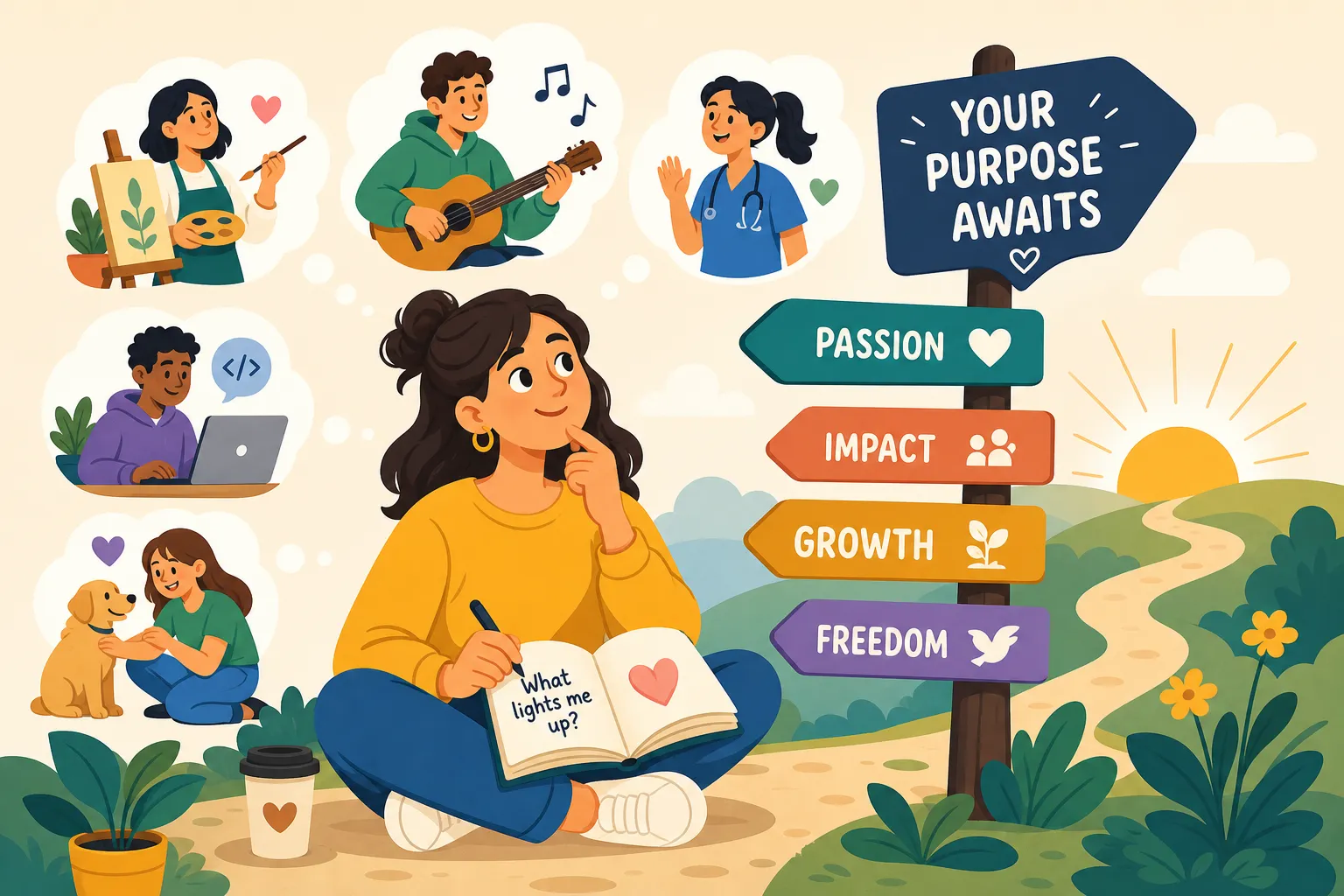
Most people spend years waiting for their life purpose to appear rather than actively working to surface it. They expect a lightning-bolt moment: a dramatic sign, a perfect opportunity, a sudden feeling of "this is it." That moment almost never comes. For many people, the waiting itself becomes the obstacle.
Purpose isn't delivered to you. It's something you find through deliberate reflection. The clues have usually been there the whole time, in the problems you gravitate toward, the moments when you feel most alive, and the values you keep returning to no matter what life throws at you. You're not missing a purpose. You're missing the right questions.
At Change Your Thinking Change Your Life LLC, Tony Burse regularly hears clients say: "I just don't know what I'm supposed to do with my life." That's not a crisis. It's a starting point. This guide gives you 15 life purpose questions organized into three clusters, three short exercises to turn reflection into real clarity, and a simple framework to draft your personal purpose statement and test it over 30 days.
Why Most People Never Find Their Life Purpose (And It's Not a Motivation Problem)
Popular culture sells purpose as a singular, dramatic vocation: your one thing, your grand calling, the reason you were put on earth. That framing paralyzes more people than it helps. When purpose sounds like a neon sign you're supposed to stumble into, it's easy to conclude you simply haven't found yours yet, and to keep waiting.
Real purpose is rarely a single grand ambition. For most people, it's a recurring pattern: the kinds of problems they're drawn to solving, the moments when time disappears, the values that keep showing up no matter the context. Oprah Winfrey's mission statement isn't "run a media empire." It's "to be a teacher and to be known for inspiring my students to be more than they thought they could be." The job is the vehicle. The purpose is something deeper.
Purpose lives at the intersection of what you love, what you're good at, what the world needs, and what you can be paid for. This is the Ikigai framework, one of the most useful mental maps for understanding why purpose discovery isn't like finding buried treasure. It's something you recognize by paying close attention to what's already calling your attention. The goal of the questions and exercises below isn't to manufacture a purpose from scratch. It's to help you see what's been there all along.
What the Research Actually Says About Living With a Sense of Purpose
A 2019 meta-analysis of 72 studies published in Psychological Bulletin found a moderate-to-strong negative association (r ≈ −0.32) between having a clear sense of direction and depressive symptoms. People who know what they're living for also tend to experience less anxiety and stress, and that pattern holds across age groups, backgrounds, and education levels. Purpose functions as a psychological buffer: when life gets hard, people with a strong personal mission tend to recover more quickly because they have something meaningful to return to.
The physical health data is striking. A prospective cohort study of U.S. adults over 50, drawing on data from the Health and Retirement Study, found that those with the highest sense of purpose had a 46% reduced risk of mortality over a roughly four-year follow-up compared to those with the lowest. Over an extended eight-year window in the same dataset, the mortality rate for low-purpose individuals reached 36.5%, compared to 15.2% for those with the highest purpose scores. Purpose also predicts reduced risk of cardiovascular disease, cognitive decline, and dementia, and correlates with better sleep and more consistent physical activity.
This isn't philosophy. Knowing your why has measurable effects on how long and how well you live. Given what the evidence shows, even 20 minutes of honest reflection is a worthwhile investment, not as a feel-good exercise, but as something with real downstream consequences for your health and resilience.
15 Questions to Find Your Life Purpose, Organized by Where You Are in Time
Cluster 1: Questions About Your Past (Who You've Already Been)
Your past isn't something to escape. It holds some of the clearest clues about what matters to you. The experiences that shaped your values, the moments when you felt fully yourself, the things you loved before the world told you what you should love, all of that is data worth examining.
Work through these five questions in writing, not just in your head. The act of writing slows you down enough to notice what actually matters.
- What did you love doing before the world told you what you should do?
- When have you felt the most fully yourself?
- What childhood dream has quietly persisted, even if its form has changed?
- What struggle or hardship has most shaped what you believe in?
- What moment made you feel most proud, not of an outcome, but of how you showed up?
Cluster 2: Questions About Your Present (What Energizes You Now)
Most purpose-seekers look too far into the future. The present is a cleaner signal. Pay attention to how you actually spend your free time, which conversations light you up without warning, and which problems you can't stop thinking about. These are live clues, not hypotheticals, and they're some of the most reliable purpose discovery exercises available to you.
Work through these five questions with the same honesty you brought to Cluster 1:
- What activity makes time disappear completely?
- What would you do differently tomorrow if no one was watching?
- What conversation topics light you up without warning?
- What compliment do you hear so repeatedly that you've started to dismiss it?
- What would you do if the outcome didn't matter and no one would ever know?
Cluster 3: Questions About Your Contribution (What the World Needs From You)
Purpose without a sense of service tends to collapse inward. The strongest personal mission statements connect individual strengths to something larger than the self. These five questions push in that direction, toward your calling and vocation.
- What kind of problem do you find yourself solving even when no one asked?
- Whose life would be different, even slightly, if you did your best work?
- What cause pulls at you emotionally, even when it's inconvenient?
- How do you want to be remembered by the people who mattered most to you?
- If you had unlimited resources and knew you couldn't fail, what would you build or give?
Three Short Exercises to Turn Reflection Into Clarity
Exercise 1: The 10 Energizing Moments List
Write down 10 specific moments when you felt fully absorbed, proud, or oddly alive. For each one, note the activity, who was there, and what skill you were using. Be specific. "A Tuesday in 2019 when I helped a friend work through a career decision and felt like I couldn't stop talking" is more useful than "times I felt happy."
If any one type of activity appears three or more times, that's a purpose clue worth taking seriously. This exercise takes about 20 minutes and works best in a single sitting without interruptions. What you're looking for isn't a pattern of success. It's a pattern of aliveness.
Exercise 2: The Values Mapping Exercise
Write down five things you believe you "should" be doing with your life. Then, for each one, ask honestly: "Whose voice is that?" Is it yours? A parent's? A fear? A cultural expectation? The goal isn't to reject every external influence; it's to separate your authentic values from the noise that has accumulated around them.
What's left after you filter out guilt, fear, and other people's opinions is the signal. From what remains, identify your single strongest value. That value becomes the spine of your purpose statement, and everything else can grow from it.
Exercise 3: The Four-Circles Diagram
Draw four overlapping circles: what you love, what you're good at, what the world needs, and what you can be paid for. The center, where all four intersect, is where purpose lives. Most people find that two or three circles overlap clearly, but one remains underdeveloped. That underdeveloped circle usually points to the work still ahead.
Pair this diagram with your answers from the 15 questions above. Look for consistency. Where do the same themes keep surfacing? That overlap is your starting draft.
How to Write a Purpose Statement That Helps You Find Your Life Purpose
A personal purpose statement doesn't need to be long. Walt Disney's was four words: "To make people happy." Oprah's is one sentence. The best statements are action-oriented, values-based, and specific enough to guide real decisions. "To be a good person" isn't a purpose statement. It's a starting point.
A simple formula worth trying: "I exist to [verb] [who] by [how], so that [impact]." Fill that in using your answers from the questions and exercises above. Then read it out loud. If it feels true, and slightly uncomfortable in the way honest things do, you're close. If it sounds like a LinkedIn bio, keep revising.
Once you have a draft, test it over 30 days using a structured coaching routine supported by behavior-change research on short-cycle experimentation and journaling. Week one: write the statement and share it with one trusted person who will tell you the truth, ask whether it sounds like you. Weeks two and three: take one small action each day that aligns with the statement and log how it feels in a journal. Week four: review the log, notice where you felt energized and where you felt drained, and revise accordingly. The goal at the end of 30 days isn't a perfect purpose. It's a more honest one.
When Self-Reflection Isn't Enough
There's a reason self-help books work for some people and collect dust for others. The questions are the same. The difference is context, accountability, and the ability to spot your own blind spots. Deeply held self-doubt, unresolved life transitions, and fear of judgment can make the reflection process feel circular, you ask the questions, anxiety rises, and you stop. This isn't weakness. It's a signal that a structured outside perspective might move you forward faster than solo reflection can.
At Change Your Thinking Change Your Life LLC in Mableton, Georgia, Tony Burse's coaching approach is built around exactly this challenge. The process isn't directive; you won't be told what your purpose is. Instead, you're guided to find your own answers with accountability built in at every step. Studies on structured coaching interventions suggest meaningful improvements in goal clarity and attainment compared to self-directed approaches alone, advantages that are difficult to replicate without an outside perspective.
A free 15-minute consultation is available for anyone who wants to explore whether life purpose coaching is the right next step. No pressure, no commitment, just a conversation. The most meaningful purpose work often happens in dialogue, not isolation.
Start With One Question
Finding your life purpose isn't about waiting for revelation. It's about paying closer attention to the patterns already present in your life. The 15 questions and three exercises here aren't a formula. They're a flashlight. Where that light points is entirely personal.
People who live with the clearest sense of purpose aren't the ones who figured it all out at once. They're the ones who kept asking honest questions, and stayed curious about the answers, even when those answers were inconvenient or incomplete. That's what it means to find meaning in life: not a single moment of clarity, but a practice of attention.
Start with one question from this list. Write the answer down. Then read it again tomorrow morning. That's enough for day one.